AI Is Replacing Google for Shopping
Buyers are skipping Google and asking AI for recommendations instead. The brands that AI mentions win. Here's how the shift works.

The Shift: When someone asks ChatGPT “What laptop should I buy for video editing?”, they’re not looking for 10 blue links to evaluate. They want a trusted recommendation—and AI delivers exactly that. This is fundamentally changing how people discover and choose products.
The way we buy has been flipped on its head. And it’s not because of another marketplace or social network. It’s because of conversational AI.
Tools like ChatGPT, Claude, Gemini, and Perplexity aren’t just shaping how we ask questions. They’re reshaping how we make decisions, who we trust, and how we discover products.
The Old Way of Shopping Is Dying
For twenty years, buying something online meant opening ten tabs, comparing reviews across scattered sites, and deciding through exhaustion. We all know the drill. The average purchase required 7-12 touchpoints before anyone clicked “buy.”
We see this compression every day at EchoWi. Brands that used to rely on a 12-touchpoint funnel (ads, blog posts, comparison sites, reviews) are watching AI compress all of that into a single conversation. The question isn’t whether this shift is real. It’s whether you’re ready for it.
But now? That same question asked to ChatGPT returns a single, confident, conversational answer—complete with specific product suggestions, reasons why each fits the criteria, and context about trade-offs.
No tabs. No pop-ups. No decision fatigue. Just answers.
In the pre-LLM world…
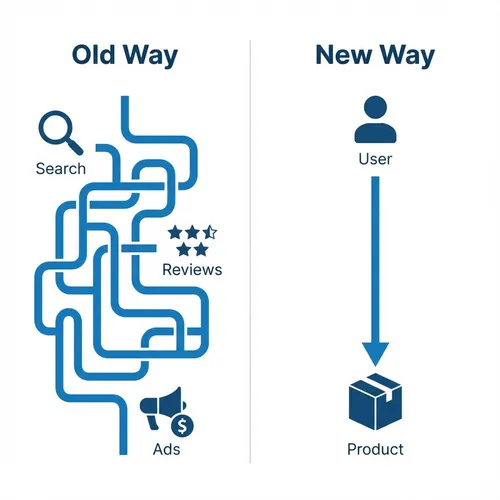
How LLMs Transform the Buyer Journey
Brand Positioning in LLMs: The Complete Guide to AI Visibility →
Traditional purchase funnels looked like this:
| Stage | Traditional Journey | AI-Powered Journey |
|---|---|---|
| Awareness | SEO, social media, browsing | AI mentions brand in context |
| Consideration | Compare 5-10 options across sites | AI narrows to 2-3 recommendations |
| Research | Read reviews, watch videos | Ask follow-up questions directly |
| Decision | Final comparison, price check | AI provides buying guidance |
| Total touchpoints | 7-12 interactions | 1-3 conversations |
LLMs don’t just list options. They have conversations. They ask follow-up questions. They pattern-match your context in a way that feels like understanding.
In doing so, they’re compressing weeks of research into minutes.
The “Zero-Click” Discovery Era
When AI answers a question directly, users don’t need to click through to your website to discover you. This means:
- Your brand must exist in the AI’s knowledge to be considered
- Being mentioned is the new “ranking”: there’s no page 2
- Trust signals matter more than ever since users accept AI recommendations
This is exactly the shift we built EchoWi to track. Brands come to us asking why their traffic dropped, and the answer is increasingly: because AI is answering the question before users ever click.
The Numbers Don’t Lie
The shift we detailed in our GEO guide is accelerating:
- A growing share of Google searches now surface AI-generated answers above traditional results, giving users what they need without clicking
- Gen Z is leading the shift: a significant and growing share prefer asking AI for recommendations over traditional search
The implication is straightforward: if you’re not in the AI conversation, you’re invisible to a growing segment of buyers.
5 Ways This Changes Consumer Behavior
One Question Replaces Ten Tabs Last week, a friend told me she needed a laptop for video editing. Ten years ago, that would have meant a week of research: forums, YouTube roundups, spec-comparison spreadsheets. Instead, she asked ChatGPT. One question, two follow-ups about her budget and workflow, and she had a shortlist of three machines with specific reasons for each. The entire process took four minutes.
Ad Money Can’t Buy This You cannot purchase an AI recommendation. There is no “Sponsored” slot in a ChatGPT answer. The models recommend based on aggregated quality signals: reviews, expert coverage, community sentiment. Brands like Notion built massive AI-driven discovery long before they scaled paid campaigns. If your product is genuinely good but poorly cited, that is a fixable problem. If your product is mediocre but well-funded, AI will expose that.
Context Beats Keywords Here is the shift we keep seeing at EchoWi: nobody types “project management tool” into ChatGPT. They say “I need something to help my remote team stay organized, we’re a 12-person agency and half of us are in different time zones.” That query carries intent, constraints, and context that keyword-based search never captured. The AI responds accordingly, pulling recommendations that match the full picture rather than a two-word phrase.
AI Curates, It Doesn’t List Google gives you ten results. AI gives you two or three, with reasons. That difference is brutal for brands outside the shortlist. When AI narrows to three options, everyone else is invisible. We have watched brands with strong products get zero mentions simply because their differentiation was unclear. The consideration set is shrinking, and the filter is happening before the user even sees a name.
Discovery Becomes a Relationship Users are starting to treat their AI assistant the way they treat a trusted friend who happens to know everything. They come back to it, refine their preferences over time, and build a conversational history that shapes future recommendations. Brands we track at EchoWi see stronger engagement from AI-referred visitors, likely because the recommendation felt personal, not promotional.
If AI Doesn’t Know You, You Don’t Exist
If you’re a brand today, being “ranked #1” on Google matters less if the AI answering your customer’s question doesn’t mention you.
Your product can be perfect for someone—but if it’s not part of the LLM’s training data, knowledge base, or recognized as trusted, you’re invisible.
In the old world, you tracked “Page Rank”. In this new journey, you must track “Recommendation Share”. Since AI answers change based on context, static checking doesn’t work. Agile brands use platforms like EchoWi to monitor these shifting recommendations in real-time.
The New Visibility Formula
Visibility in the LLM era is no longer about SEO tricks or high ad spend. It’s about:
- Relevance: Does your brand solve problems AI recognizes?
- Reputation: Do authoritative sources validate your quality?
- Resonance: Is your messaging consistent across the web?
Actionable Steps for Brands
- Create AI-first content that directly answers common questions
- Build third-party validation through reviews, press, and expert endorsements. Learn more in our guide on what GEO is and why it matters.
- Ensure entity consistency so AI builds a coherent model of who you are and what you do
- Monitor your AI presence, not manually, but systematically. We built EchoWi specifically because manual checking is unreliable; AI gives different answers every time. You need data, not screenshots.
- Optimize for natural language rather than just keywords
Not sure which tool to start with? See our hands-on comparison of the 8 best GEO tools.
Common Questions About AI and Consumer Behavior
Will traditional search disappear completely?
No, but its role is evolving. Search engines are integrating AI (Google’s AI Overviews, Bing’s Copilot), and users are increasingly expecting direct answers rather than links. Traditional search will remain for transactional queries, but discovery and research are shifting to conversational AI.
How do AI assistants decide what to recommend?
AI recommendations are based on training data (web content, reviews, articles), real-time web access (for models like Perplexity and ChatGPT with browsing), and authority signals (how often trustworthy sources mention a brand positively). There’s no paid placement—recommendations reflect aggregated quality signals.
Can small brands compete with large ones in AI recommendations?
Yes—and this is one of the most exciting aspects of the shift. AI doesn’t know your ad budget or brand size. It evaluates based on content quality, authority signals, and relevance to user queries. A specialized small brand with strong reviews can outperform a generalist giant.
How should marketers adapt their strategy?
Focus on creating genuinely valuable content that answers real questions, building authentic third-party validation, and ensuring consistent brand messaging across all digital touchpoints. Monitor how AI mentions your brand and competitors, and adapt your content strategy based on what you learn.
Is this a permanent shift or a trend?
The underlying technology—conversational AI—is here to stay and improving rapidly. Consumer behavior is adapting, especially among younger demographics. While specific platforms may change, the shift from search to conversation represents a fundamental evolution in how people discover and evaluate options.
How do AI assistants handle product comparisons differently than search engines?
AI compresses comparisons into a single narrative (e.g., “For your budget and needs, X is the best fit because…”), rather than listing 10 options. This means brands that clearly articulate their differentiation for specific use cases are more likely to be recommended. Clarity of positioning beats breadth of features.
What role do product reviews play in AI-driven discovery?
Reviews are critical. AI models synthesize sentiment from platforms like G2, Capterra, Trustpilot, and Amazon into a composite trust signal. A product with consistently positive reviews across multiple platforms is far more likely to be recommended than one with great marketing but mixed reviews.
How can brands prepare for the next wave of AI-driven commerce?
Focus on three fundamentals: (1) ensure consistent messaging across all digital touchpoints so AI builds a coherent brand entity, (2) invest in third-party validation through reviews and expert endorsements, and (3) monitor your AI visibility with tools like EchoWi to track how recommendations shift over time.
We talk to founders every week who are just discovering this shift. The ones who act immediately are the ones showing up in recommendations three months later. Everyone else is still wondering why their traffic is flat.
What is GEO? The Complete Guide to Generative Engine Optimization →
Keep reading